|
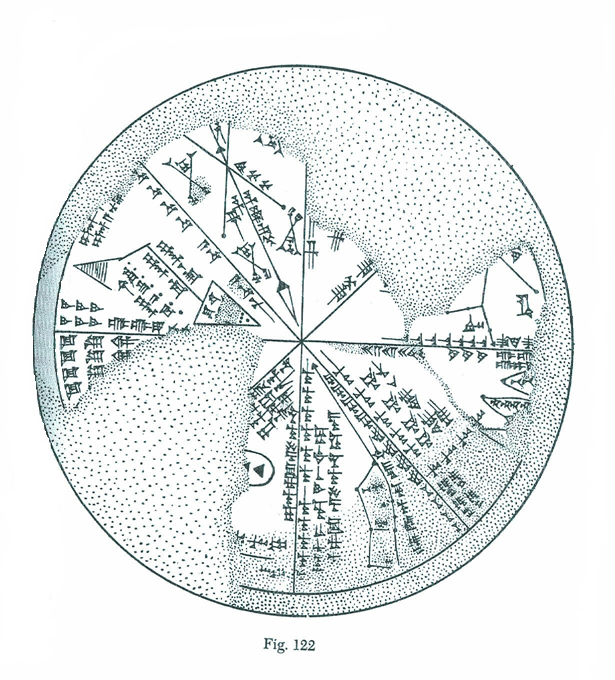
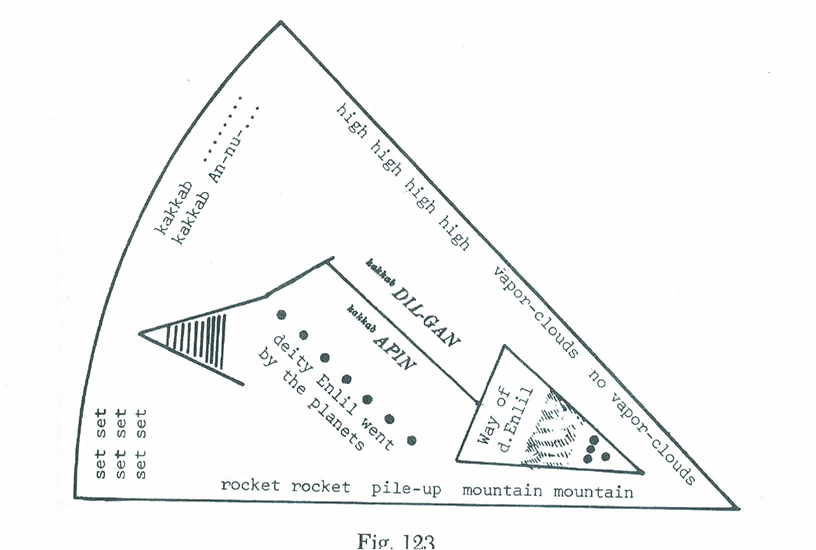
GOING TO MARS What is NASA Looking For? --First of two articles? The planet Mars is back in the news. This time, in spite of preceding failures (by Japan, Britain) of Mars missions, manmade Landers and their robotic rovers ? NASA?s Spirit and Opportunity -- made it safely and successfully to the Red Planet. A spacecraft launched by the European Space Agency, Mars Express -? a companion to the British failed lander/rover mission -? is safely in orbit around Mars. And the initial indications, and photographs, already suggest that the assumption underlying these missions will be proven true; That Mars was once a planet with water -? rivers, lakes, perhaps even seas; and that some of that water is still there. Although the current explorations on Mars in search of water (then or even now) have been presented as a new endeavor triggered by photographs of the surface of Mars taken in 1996 (Mars Global Surveyor) and since 2001 (Mars Pathfinder), the fact is that photographs taken two decades and more ago, by the Mariner spacecraft, already showed such evidence. In my book Genesis Revisited, 1990, I reproduced NASA?s own photographs to show evidence of water flows and shorelines, and concluded unequivocally that, at least in the past, Mars was a watery planet. Searching for ?Life?So what exactly is NASA searching for? Though only indirectly, with a wink or a Mona Lisa smile, NASA?s leaders say that ?where there was water there could be life.? Officially, they are all just searching for evidence of water. If water is still there, it would make it so much more feasible to achieve the vision -? declared by President George W. Bush ?- of sending people from Earth to Mars. A dream for the future! In the midst of such exciting developments, it seems to me appropriate to tell to All Who May Be Concerned: Travel between Earth and Mars by intelligent beings has already been achieved -? tens of thousands of years ago! The Sumerian EvidenceThe evidence for that was recorded ?- in words and illustrations -? by the Sumerians, whose civilization blossomed out in Mesopotamia (now mostly Iraq) some six thousand years ago. They did not claim the achievement of visiting Mars for themselves. Rather, they wrote on their clay tablets about the Anunnaki (?Those who from Heaven to Earth came?) who came to Earth from their planet Nibiru, a twelfth member of our solar system (counting, as they did, the Sun, Moon and ten planets) whose great elliptical orbit around the Sun lasts some 3,600 (Earth-) years. The many ancient texts, unearthed by archeologists, that deal with the Anunnaki, their comings and goings, and the astronomical knowledge (among other sciences) that they bequeathed to Mankind, have been revealed and explained in my series of books, beginning with The 12th Planet. Moreover, the texts have been accompanied by illustrations found on clay tablets or drawn on cylinder seals. In texts dealing with the actual space travel between the planets, Earth was designated as the seventh planet ? which indeed it is but only if one counts from outside-in, where Pluto would be the first, Neptune the second, Uranus and Saturn third and fourth, Jupiter the fifth, Mars the sixth and Earth the seventh. In those texts, Mars was called ?The Way Station? ? a stopover place between Nibiru and Earth. And, amazingly but true, a circular tablet that can be seen on display in the British Museum in London, describes in eight segments various aspects of space travel between the Anunnaki?s planet Nibiru and the ?Seventh Planet? (Earth) ? Fig. 122 in The 12th Planet. One segment in particular, enlarged here for clarity, (Fig. 123 in The 12th Planet) shows (and states) that the route traveled by Enlil (?Lord of the Command?) entailed passage by seven planets; it also called for a route diversion between the planet DILGAN (Jupiter) and APIN (Mars): |
|
 |
 |
|
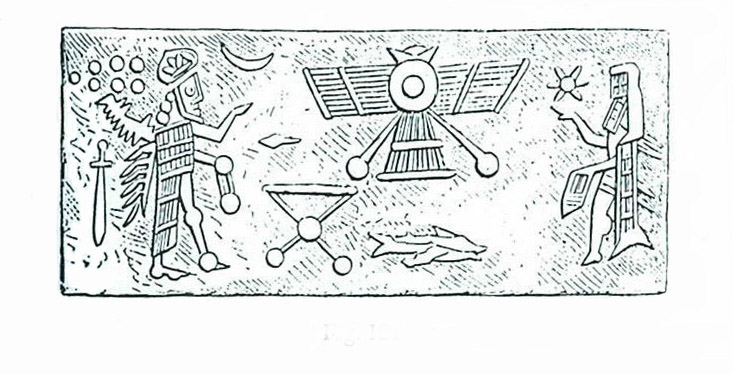
Mars as a way station In their texts the Sumerians wrote that the Anunnaki traveled to Earth in groups of fifty. The first team, under the leadership of E-A (?Whose home is water?) splashed down in the waters of the Persian Gulf, waded ashore, end established ERIDU (?Home in the Faraway?). In time, 600 Anunnaki were deployed on Earth and another 300 operated shuttlecraft between Earth and Mars ? yes, Mars! Pictorial evidence for the Earth-Mars connection is provided by a depiction on a cylinder seal (now kept at the Hermitage Museum in St. Petersburg, Russia) ? Fig. 121 in The 12th Planet: |
|
|
|
|
|
It depicts an astronaut (?Eagleman?) on Earth (the planet marked by the seven dots, accompanied by the crescent of the Moon) and an astronaut on Mars (the six-pointed star symbol) ?- the latter depicted as one from the ?Fishmen? class of astronauts, those equipped to splashdown in waters. nbsp;Between the two planets an object is depicted, that could only be a spacecraft, with extended panels and antennas. A Space Base on Mars To maintain, over thousands of years, a space base on Mars required water for survival. The ?Fishman?s? attire of the one on Mars suggests bodies of water on Mars. Moreover, as detailed in my latest book The Lost Book of Enki (?Lord Earth,? a later title for Ea), water was used by the Anunnaki to propel their spacecraft; and the availability of water on Mars made it a suitable way-station. The Anunnaki, I have concluded in my books, used Mars not just for a quick stopover; they created a permanent space base on Mars, complete with structures and roads. In Genesis Revisited I reproduced numerous photographs taken by NASA?s Mariner-9 in 1972 and Viking-1 Orbiter in 1976 that clearly showed a variety of artificial structures there. Some of them were in the Cydonia area with its famed ?Face.? Not only such ancient evidence, but NASA?s own photographs from the 1970?s onward, indicated the presence of water on Mars. A search for watery evidence is thus, no great innovation. Searching ? Or AVOIDING? The current search for evidence of water on Mars is hinted as an indirect effort to find evidence for ?life? on Mars. But as in a previous attempt to test Martian soil (that was deemed unsuccessful), the current one looks again, at best, for evidence of microbial life. This impels one to ask: Why is NASA not sending its rovers to such areas as Cydonia, where its own photographs have shown remains of artificial structures (to ignore, for a moment, the ?Face?)? As exciting as a discovery that microbes had been on Mars would be -? isn?t the avoidance of closer looks at areas with structures (and the Face) indicative of a desire to not find real Life on Mars ?- the life represented by intelligent beings who fashioned us to look and be like them? For those who launch the space missions, the word ?Extraterrestrials? remains taboo. ZECHARIA SITCHIN ---------------------------------- |
|